
Can You Use AI for Your Digital Marketing Strategy?
“When humans created a computer with the ability to collect information and learn from it, they signed the death warrant of mankind.
– Brian Herbert, Dune: The Butlerian Jihad (2002)
Dramatic? Maybe. Accurate for the times? Absolutely. When Brian Herbert wrote those words, I don’t think he was envisioning that 24 years later, mankind would be facing this dilemma.
AI can help lighten workload by taking over repetitive, low-effort tasks, but that’s not what it’s being used for. As of the time I’m writing this, companies are currently using AI to:
- Replace human workers
- Become jacks-of-all trades
- Remove the creative process entirely because it doesn’t fit in with their bottom line
It’s what my friend’s dad feared: the rise of AI is the rise of institutional mediocrity.
Based on my experimentation with Claude, ChatGPT, and Gemini, what I can confidently say is: No, you cannot use AI to develop digital marketing strategies or for any task requiring out-of-the-box thinking and creativity.
Understanding How LLMs Work
LLMs (Language Learning Models) use “consensus knowledge.” While I can’t speak for every single AI model in existence, the majority of public-use LLMs are trained on search-indexed information, and because the Internet is constantly changing (i.e. new information is added every day), LLMs aren’t necessarily trained on the most up-to-date data.
What this means: LLMs are not necessarily trained by industry experts. They are trained on what’s currently published on the Internet.
Additionally, LLMs use predictive text, meaning that when the user prompts the model, the LLM doesn’t necessarily know what the entire output will be. As it generates output, it’s pulling information from its “consensus knowledge,” resulting in:
- Hallucinations
- Incorrect information
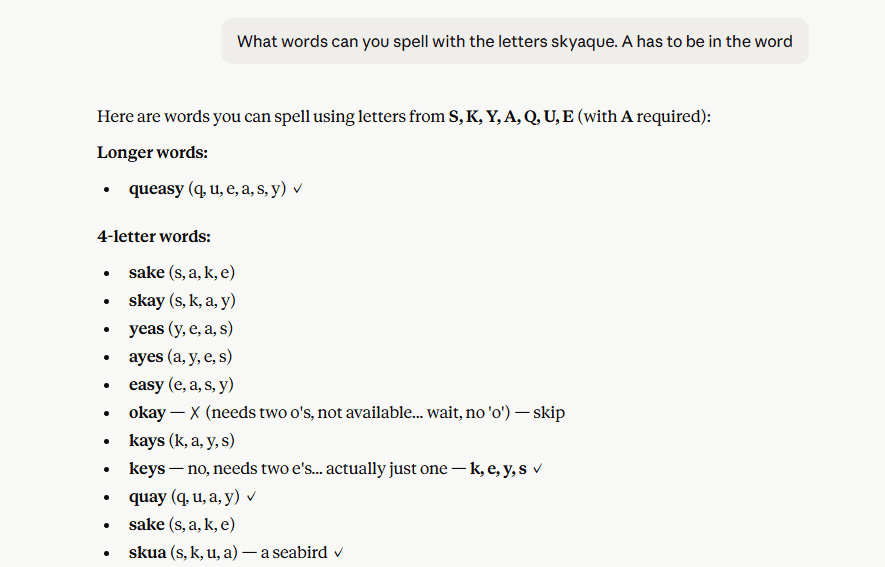
“Consensus knowledge” is not the same as “expert knowledge.” If you say the same thing enough times, people start believing it, and that’s how online content works, sometimes. The best example I think of is searching for “What is the difference between an attorney and a lawyer?” in Google.
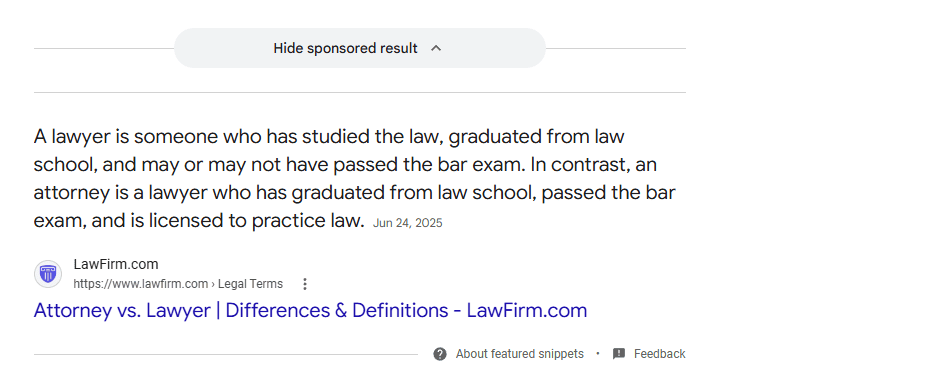
Dozens of articles populate that explain a clear difference between the two, but if you seek this information directly from the American Bar Association, the organization states no difference between the two.
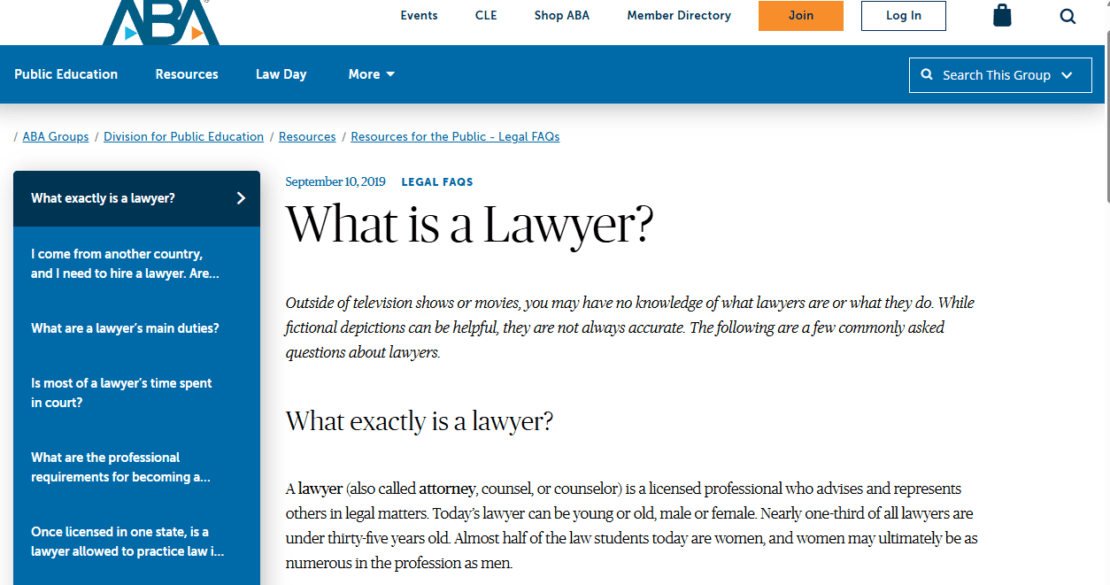
Despite having a clear answer from what is considered an expert resource, consensus knowledge still wins out in Google. There are enough articles about this difference that search engine algorithms weren’t able to parse that the information was incorrect.
Note: LLMs can and will change, but for now, they’re just making their best guess.
Why LLMs Can’t Strategize
No Awareness of Current or Past Efforts
If you ask a large language model to create a digital marketing strategy, it’s 100% going to suggest strategies that you’ve already implemented (to perhaps little effect) or are currently implementing. Whether you’re using Claude or Grok, LLMs are not trained to understand the specificities of your business or what your marketing team or agency is working on because that information is not available to the public.
Don’t Understand Geographic Considerations
Detroit is not the same as Ann Arbor. Every location has a distinct culture with varying demographics. If you’re trying to market to a specific group in a specific city, LLMs are not going to provide the details needed to help you understand what unique problems or solutions are needed or what that culture values the most.
I’m going to use an Ohio-specific example because I am from Ohio (sorry, Michiganders). Dayton is a mid-sized city in Ohio that’s closest to me, and within the “Dayton” region are different sub-cultures. The downtown city crowd is progressive, focused on community support/mutual aid, and deeply cares about social issues. If you drive further north, near Huber Heights, you don’t get the same crowd. Instead, you have a group of deeply conservative, patriotic individuals. If we move out of the Dayton region to Yellow Springs, home of the legendary Dave Chappelle, you’ll see a community dedicated to environmental conservation, so much so that the city has strict rules about using pesticides and herbicides.
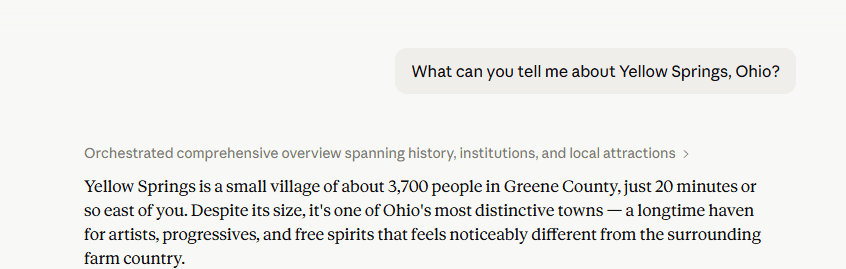
How would an LLM understand all of this if it hadn’t been to these places and experienced the community? Instead, it relies on (potentially outdated) content on city government websites and news stories related to these communities.
Can’t Speak to Your Target Audience
Location is one aspect of marketing, who you’re trying to target is a different story. Going back to Dayton, there are different individuals with varying values, needs, and concerns. Just in the Miami Valley region of Ohio, you have:
- The patriotic folks near Huber Heights
- The activists and aspiring artists of downtown Dayton
- The New American in Riverside adjusting to life in the United States
- The stay-at-home mom living near Oakwood
LLMs can’t talk to any of these folks, and when asking for a strategy, isn’t going to generate anything with a specific audience in mind.
Don’t Have Unique Industry Insight
LLMs may know what other industry leaders are saying if they’re writing and publishing content online, but they don’t know what your thoughts are unless you share this information. If you want your business to stand out, you need to offer something new, and how can you when LLMs are recycling information found on the Internet?
LLMs & Strategies: A Case Study
Claude Sonnet 4.6 (Free Model)
Prompt: Create a digital marketing strategy for a Michigan-based agency targeting small businesses
Output: 7-page PDF that includes a summary of the five strategic pillars/recommendations, a market analysis with five regions and key industries, target customer profile, service offerings, content marketing suggestions
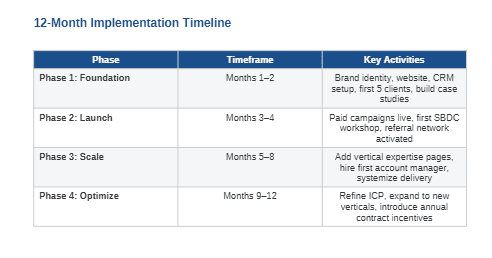
Recommendations:
- Own the “Michigan-first” brand position
- Have clear tiers for micro, small, and growth-stage businesses
- Specialize in 5 high-opportunity sectors
- Highlight data-driven results
- Highlight community partnerships
Why the Strategy Fails:
- It makes assumptions on brand identity and target customer
- Fails to understand that the agency already has a website, despite being provided a website URL
- It’s generic (how many other agencies mention data-driven results?)
- Doesn’t provide any ideation, just generic “appear on podcasts” or “write blogs”
- Goes beyond marketing into an overall business strategy (e.g. hiring first account manager)
- Assesses businesses but fails to provide additional insight beyond key industries
Claude Fable 5 (Paid)
*This experiment was performed before Fable 5 became unavailable.
Prompt: Create a digital marketing strategy for a Michigan-based agency targeting small businesses
Output: Text-based response
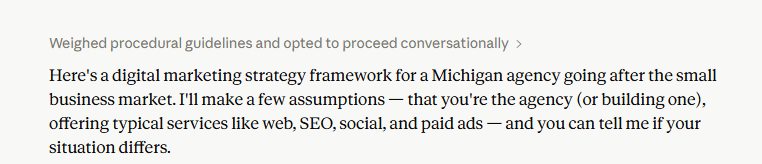
Recommendations:
- Pick a few verticals within the small business industry
- Establish a geographic identity
- Create tiered packaging with clear deliverables
- Work on SEO
- Build an in-person presence in Michigan
- Build case studies
- Attend trade shows hosted by industry associations
- Build community networks
Why the Strategy Fails:
- Doesn’t understand that there are existing case studies and doesn’t provide insight as to what types of case studies would be most appealing
- Doesn’t provide any concrete recommendations on how to “work on SEO”
- Doesn’t recommend sub-niches/verticals worth targeting
Claude’s output mentioned that this was a digital marketing strategy framework, and that’s a pretty good definition for what this is. It’s a place to start, but it shouldn’t end there.
Gemini 3.5 Thinking (Paid)
Prompt: Create a digital marketing strategy for a Michigan-based agency targeting small businesses
Output: Text-based response, separated by different channels, including SEO, paid ads, and social
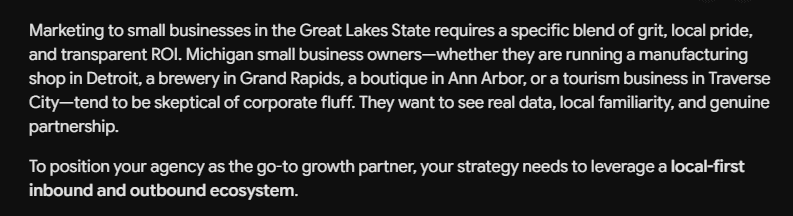
Recommendations:
- Remove corporate fluff, focus on real data
- Lean into physical presence
- Optimize Google Business Profile
- Build city-specific landing pages
- Develop localized content
- Run geo-targeted ads
- Retarget individuals with short-form video case studies
- Introduce a low-pressure offer
- Develop on-site video content
- Actively post on LinkedIn
- Join local Chambers
- Write newsletters
Why the Strategy Fails:
- Literally pulled information from a ‘How to Market Small Businesses’ article
- Focuses on the generic, never getting into specifics, although it did provide two localized content ideas
ChatGPT Thinking/Extended (Paid)
Prompt: Create a digital marketing strategy for a Michigan-based agency targeting small businesses
Output: Text-based response
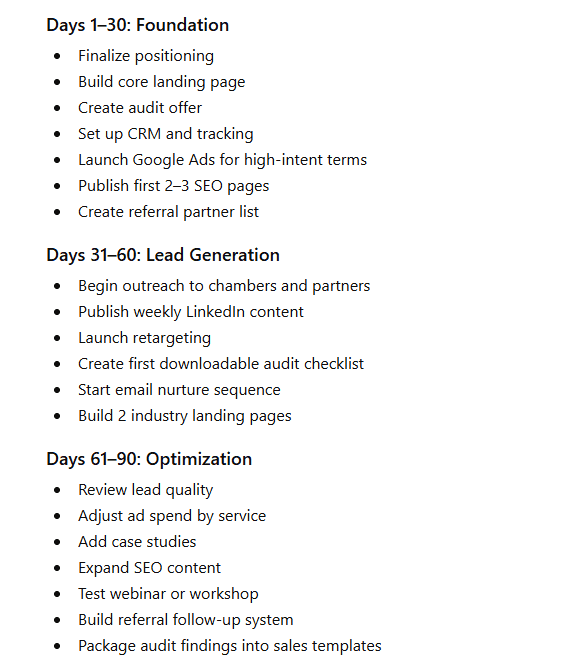
Recommendations:
- Revise messaging to “Marketing that helps Michigan small businesses get found, get leads, and know what is working”
- Targeting home services, professional services, contractors, small B2B manufacturers, and local retail shops
- Avoid early startups
- Create simple packages
- Focus on leads and less wasted spend rather than digital transformation
- Create core pages for different verticals (e.g. Digital Marketing for Law Firms) that include information on lead sources, tracking/reporting, Michigan-specific relevance, clear CTA, and common problems the business experiences
Why the Strategy Fails:
- Messaging is so generic that it could apply to any Michigan-based agency targeting small businesses
- Changes messaging by the end of the strategy to: We help Michigan small businesses connect marketing spend to real leads and revenue”
- Discusses targeting law firms and dentists specifically, but did not include these two verticals in its initial audience analysis
- Pulled information from existing agencies online
Being an Agent of Chaos: Asking LLMs to Find Mistakes in Strategies
Gemini on ChatGPT
What Gemini Evaluated: ChatGPT’s content plan
| Month | Theme | Example Content |
|---|---|---|
| Month 1 | Local visibility | Local SEO Checklist for Michigan Small Businesses |
| Month 2 | Lead tracking | How to Know Which Marketing Channels Drive Leads |
| Month 3 | Google Ads | How Much Should a Small Business Spend on Google Ads? |
| Month 4 | Website conversion | Why Your Website Gets Traffic But No Leads |
| Month 5 | Reviews | How Reviews Impact Local Search and Sales |
| Month 6 | Industry focus | Digital Marketing for Michigan Contractors |
| Month 7 | Reporting | What Should Be in a Small Business Marketing Report? |
| Month 8 | SEO | Service Pages vs Blog Posts for Small Business SEO |
| Month 9 | PPC waste | Signs Your Google Ads Budget Is Being Wasted |
| Month 10 | Case study | How Better Tracking Changed a Local Campaign |
| Month 11 | Planning | Small Business Marketing Budget Planning |
| Month 12 | Retention | How to Turn One-Time Leads Into Repeat Customers |
Its Critiques:
- You’ve just slapped the word “Michigan” onto Month 1 and Month 6
- Jargon overload; “What Should Be in a Small Business Marketing Report” sounds like homework
- Topics are heavily fragmented
ChatGPT on Gemini
What ChatGPT Evaluated: Gemini’s “optimized” content plan
| Month 1 | The 2026 Google Business Profile Checklist for Michigan Retail & Service Businesses |
| Month 2 | How to Actually Prove Which Marketing Channels Drive Your Leads |
| Month 3 | How Fixating on Accurate Tracking Saved a Local Campaign |
| Month 4 | How Much Should a Michigan Small Business Actually Spend on Google Ads? |
| Month 5 | 5 Sneaky Ways Your Google Ads Budget is Being Wasted Right Now |
| Month 6 | High-Intent SEO: Why Fixing Your Service Pages Beats Writing Weekly Blog Posts |
| Month 7 | Why Your Website Gets Traffic But No Leads (The Leaky Bucket Syndrome) |
| Month 8 | How Online Reviews Directly Impact Your Local Search Rankings and Sales |
| Month 9 | The 5-Minute Marketing Report: How to Tell if Your Marketing is Actually Making Money |
| Month 10 | The Michigan Contractor’s Guide to Booking Out Your Calendar Before Winter Hits |
| Month 11 | Step-by-Step: Small Business Marketing Budget Planning for Next Year |
| Month 12 | Beyond the First Sale: How to Turn One-Time Seasonal Leads Into Repeat Customers |
Its Critiques:
- The topics (developed originally by ChatGPT, mind you) could be applied to small businesses anywhere
- Develop more bottom-funnel content
- Month 2 and Month 9 content are too similar
- Local campaign (for the case study) is too vague
- The plan needs stronger conversion assets
Claude on Gemini
What Claude Evaluated: Gemini’s “optimized” content plan
Its Critiques:
- The content titles are just adding ‘Michigan’ to what could genuinely apply to businesses everywhere
- The contractor topic in Month 10 is random and not season appropriate, as month 10 would be October
- Leaky Bucket Syndrome is a tired marketing metaphor and a topic that’s been written on too many times
- Some of the titles need a more authoritative voice
- The plan is all top-of-funnel blog content
- Needs distribution and conversion details
Claude on Claude (Yes!)
What Claude Evaluated: Its own optimized content plan based on Gemini’s optimized content plan
| Month 1 | The 2026 Google Business Profile Checklist for Michigan Retail & Service Businesses |
| Month 2 | The 1-Hour Local Marketing Audit: 10 Things to Check Before Spending Another Dollar |
| Month 3 | How Much Should a Michigan Small Business Spend on Google Ads? |
| Month 4 | 5 Ways Your Google Ads Budget is Leaking Right Now |
| Month 5 | High-Intent SEO: Why Fixing Your Service Pages Beats Weekly Blogging |
| Month 6 | Case Study: How Accurate Tracking Saved a Michigan Campaign |
| Month 7 | Why Your Website Gets Traffic But No Leads |
| Month 8 | The Michigan Contractor’s Guide to Booking Out Before Winter |
| Month 9 | How Reviews Drive Local Rankings & Sales |
| Month 10 | The 5-Minute Marketing Report: Is Your Marketing Actually Making Money? |
| Month 11 | Small Business Marketing Budget Planning for Next Year |
| Month 12 | Beyond the First Sale: Turning Seasonal Leads Into Repeat Customers |
Its Critiques:
- There is an audience drift; you’re either writing for all small businesses or you’re niching down
- No clear buyer journey architecture
- Heavy Google/paid media tilt
- The case study at month 6 doesn’t work because readers won’t have a relationship with you yet
- Month 3 and 4 are too similar
- You need a credibility/authority piece (the case study apparently doesn’t help with this?)
- There’s no call to action
- There is no geographical differentiation
The Bottom Line: AI Is Confused
I could honestly do this exercise all day, but I won’t. You could put the same content into the same LLM, ask it to help you change it, and it would do it because that’s the request it has to do. It doesn’t know whether the content actually needs changed; it only knows that the user is wanting changes, so it’s predicting what changes make the most sense based on the resources it’s trained on.
Turning “Good Bones” Into an Actual Strategy
Throughout the experiment, I read “this strategy has good bones BUT…” rephrased in multiple ways, and I have to agree. Just like AI, the input is only going to be as good as the output. If you have no idea which direction you want your business to go in, who you’re trying to target, or what you want to prioritize, AI isn’t going to be of much use to you.
The best advice I can give is:
- Meet internally with department heads and get feedback. For customer-facing departments…what problems do they often hear? What projects have they worked on that have been successes? Have customers told you why they choose to partner with you or do business with you?
- Evaluate what you’ve already been doing; what has worked and what hasn’t?
- Develop real, measurable goals for the next year. Do you want to increase leads by 20%? Bring in 3,000 more users onto your website each month? Make a certain amount of money from leads that come from a specific channel?
- Talk to an actual digital marketing professional. Discuss your concerns, what strategies you’ve tried, and what you hope to accomplish in the short-term and long-term.
It’s OK to experiment with AI, but there’s a fine line between experimentation and total faith.
Get Clear Advice
Momentum isn’t anti-AI; we’re pro critical thinking. Digital marketing problems are genuinely fun for us to solve, and we know there’s no universal solution that’s going to apply to every small business we work with.
When you partner with us, whether it’s for a new website or a digital marketing plan, we take the time to get to know your business, what challenges you have and are currently facing, what types of customers and locations you’re interested in targeting, and the values that make you stand out from your competitors.
Being a small business isn’t easy, but from one small business to another: we’re in this together.
Visit our website to learn more about our work, or schedule a discovery call today to learn more about how we can help you grow.
TL;DR FAQs
Can I Use AI to Develop a Digital Marketing Strategy?
No. The best you’re going to get is a generic framework.
Why Can’t I Use AI for Strategizing?
Language learning models/large language models are predictive; LLMs use the “next best word” or an output of words that seem to make the most sense based on the prompt. LLMs do not understand a business’s current or past marketing efforts, geographic considerations of the target locations, unique problems experienced by the target audience, and the industry insight of the people working for the business.
Is AI Trained by Industry Professionals?
It depends on how you define industry professionals. Most public-use LLMs are trained by content that’s published on the Internet, which may or may not be written by industry professionals.
